Dataset Analysis
Research Methodology
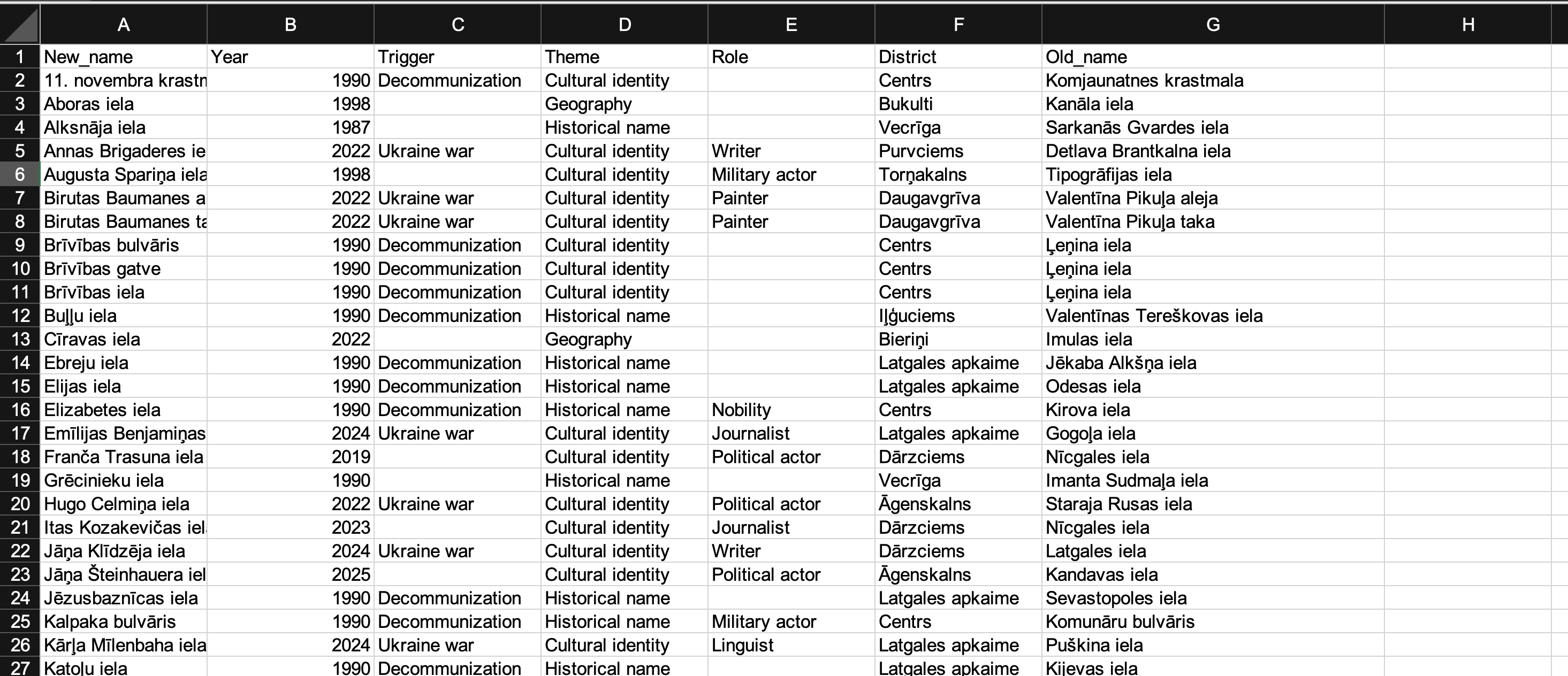
To implement the project, a specialized dataset was created and processed, reflecting the process of street renaming in Riga from 1990 to 2025. This data array became the basis for analysis, visualization and construction of an interactive map, allowing to trace how the city’s toponymy has changed over more than three decades.
The information was collected from various reliable sources, including regulatory acts of the Riga City Council, publications in the official publication Latvijas Vēstnesis, historical reference books, archival documents, as well as materials from Latvijas Valsts vēstures arhīvs. Additional information was obtained from public digital databases and media archives covering events that influenced changes in the city’s symbolism.
The final version of the dataset included 56 cases of street renaming. For each entry, a pair of the old and new name was recorded, the year of the change was indicated, and event triggers such as decommunization, geopolitical conflicts, or cultural initiatives were recorded. Thematic categories related to the motives for renaming (e.g. cultural identity, memory, geography), and the occupation or social status of the people after whom the streets were named were also reflected. The city district where the change took place was also indicated.
The collected data were used for geocoding, which made it possible to build a visual model reflecting where and when renaming took place, which districts were subject to changes most often, and how this is related to specific historical events. Thus, the dataset became the main tool for studying symbolic transformations in the urban environment of Riga.
🏛️ Riga Streets Analytics
Interactive Animated Data Visualization • 1990-2025
Analysis of Street Renamings in Riga (1987-2025)
Timeline Evolution: When Streets Were Renamed
The “Timeline evolution” graph reveals how symbolic changes in Riga’s urban space reflect major political and historical events. Based on factual data about each renaming case, this visual approach shows both the total number of renamings and their distribution over time.
Late Soviet Period (1987-1991)
- Early signs of change: As early as 1987, isolated cases of abandoning ideologically charged names indicated shifting public sentiment
- Limited activity: Renaming occurred in scattered locations during this period
Post-Independence Surge (1991-1994)
- Mass decommunization: The main surge in activity occurred immediately after Latvia regained independence in 1991
- Systematic replacement: Streets named after Soviet figures and concepts were replaced with:
- Latvian names
- Pre-war historical names
- Neutral alternatives
Quiet Period (1995-2013)
- Minimal activity: A long period with very few renamings
- Mission accomplished: The most problematic symbols had already been removed
- Background issue: Street toponymy temporarily faded from public attention
Ukrainian War Response (2014-2025)
- Renewed activity: New wave beginning after 2014
- Peak period: 2022-2025 shows the highest concentration of recent renamings
- Trigger event: Russia’s invasion of Ukraine sparked rethinking of Russian symbolic presence
- New focus: Streets associated with Russian culture or geography were renamed in favor of:
- Ukrainian resistance symbols
- Latvian historical references
Main Triggers: Why Streets Were Renamed
The pie chart analysis reveals the primary motivations behind street renamings in Riga from 1987 to 2025.
Decommunization (Largest Share)
- Historical context: Massive changes after Latvia’s independence in 1991
- Urgent necessity: Need to remove Soviet presence from public spaces quickly
- Ideological conflict: Soviet ideology contradicted the values of the newly independent state
- Scale: The largest category due to comprehensive nature of the changes needed
Ukraine War Response (Second Largest)
- Time concentration: Covers only a few years (starting 2022) but has high impact
- Emotional intensity: Sharp public reaction and active derussification policy
- Rapid decisions: Many renamings made in short time period
- Symbolic distancing: Support for Ukraine and rejection of Russian influence symbols
- High relative share: Despite fewer total renamings than 1990s, concentrated timeframe creates significant proportion
Geographic Distribution: Which Districts Were Most Affected
The “Street Renamings by District in Riga” chart shows how the 56 renamed streets from 1987 to present were distributed across the city.
Central Districts: Highest Activity
Why central areas saw most renamings:
- Symbolic importance: Form the historical, administrative, and symbolic core of Riga
- Institutional presence: House government buildings, museums, memorials, and public gathering spaces
- City’s “face”: Represent the most visible and contested identity spaces
- Political priority: Central streets are first targets during political transitions
- Historical legacy: Many bore Soviet-era names requiring urgent attention during decommunization
Peripheral Districts: Limited Activity
Districts with fewer renamings:
- Zolitūde
- Bolderāja
- Dārzciems
- Imanta
Reasons for lower activity:
- Neutral naming: Many streets had geographically descriptive or non-ideological names
- Soviet-era development: Residential areas built during Soviet period with less provocative naming
- Lower symbolic visibility: Fewer government institutions or central monuments
- Reduced priority: Not focal points during waves of political renaming
Conclusion
This analysis demonstrates that street renaming in Riga serves as a visual reflection of collective memory and political choice. The data reveals not just statistical patterns, but the deep connection between urban toponymy and historical events, showing how cities literally reshape their identity through the symbolic act of renaming their streets.